Português



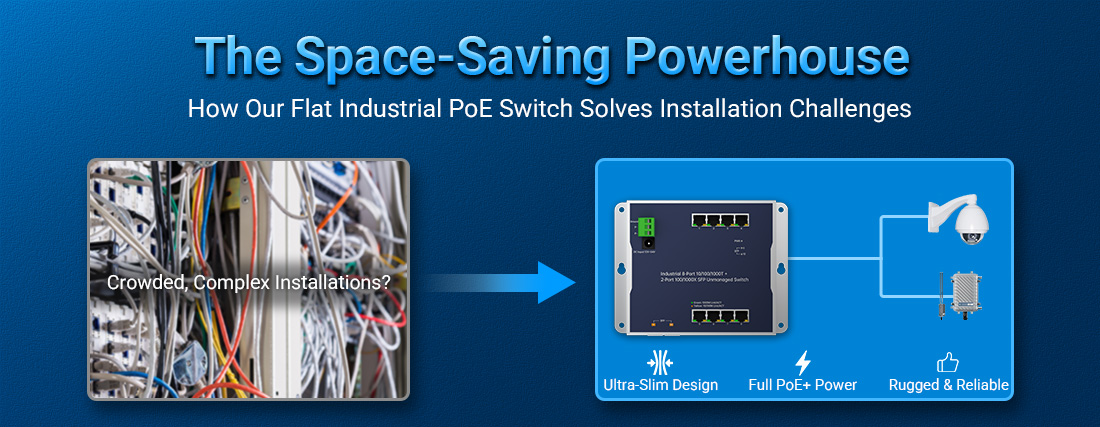
À medida que a infraestrutura de rede se expande para todos os cantos da automação industrial, segurança e edifícios inteligentes, os engenheiros enfrentam um adversário persistente e frequentemente negligenciado: o espaço. Os switches industriais tradicionais, montados em racks ou volumosos, exigem uma área considerável em painéis de controle, que muitas vezes já estão lotados de PLCs, inversores de frequência e dutos de cabeamento. Essa restrição espacial transforma instalações rotineiras em quebra-cabeças complexos, dificultando o fluxo de ar, o acesso para manutenção e futuras expansões. Da perspectiva do pesquisador, a solução reside não apenas na miniaturização, mas em um redesenho holístico que une um formato compacto de switch PoE industrial com robustez inquestionável e fornecimento de energia inteligente, abordando diretamente esses principais desafios de instalação.
Nossa inovação em engenharia se concentra em um design de switch ultrafino com caixa metálica que redefine a flexibilidade de implantação. Com um perfil geralmente inferior a 30 mm de altura, esse formato plano permite a instalação em locais antes considerados impossíveis: caixas de parede rasas, calhas de cabos apertadas ou diretamente atrás de equipamentos montados, como câmeras IP e pontos de acesso. Esse design compacto não compromete a robustez. A carcaça de metal reforçado oferece proteção superior contra impactos físicos e interferência eletromagnética (EMI), o que é crucial em ambientes com máquinas pesadas ou aplicações em material rodante. Além disso, os dispositivos projetados para essas condições exigentes geralmente apresentam amplas faixas de temperatura operacional e componentes de proteção, como proteção contra surtos de 6 kV integrada, garantindo confiabilidade desde o chão de fábrica até ambientes externos.
O verdadeiro potencial desta plataforma é liberado através do gerenciamento avançado de Power over Ethernet (PoE). Ao integrar a transmissão de dados e energia em um único cabo Ethernet padrão, esses switches eliminam a necessidade de cabeamento elétrico separado para os dispositivos finais. Isso simplifica drasticamente o processo de instalação, reduz os custos com materiais e aumenta a segurança do sistema. O gerenciamento inteligente de PoE é crucial, pois aloca dinamicamente um orçamento total de energia PoE (por exemplo, 130 W) entre todas as portas, priorizando ou desligando a energia automaticamente para evitar sobrecargas e prolongar a vida útil do sistema. O suporte a padrões como o IEEE 802.3at (PoE+) garante a compatibilidade com uma ampla gama de dispositivos de alta potência, desde câmeras PTZ até pontos de acesso sem fio, oferecendo até 30 W por porta.
Para aplicações que exigem longas distâncias, como segurança perimetral ou monitoramento extensivo de armazéns, a capacidade de transmissão PoE de longo alcance é um diferencial crucial. Modos especializados podem estender a distância operacional do Ethernet padrão muito além do limite de 100 metros. Pesquisas e implementações de produtos demonstram que, com a tecnologia apropriada, energia e dados podem ser fornecidos de forma confiável a dispositivos a até 250-300 metros de distância, superando um dos obstáculos geográficos mais comuns em instalações sem a necessidade de repetidores adicionais ou injetores intermediários.
Em conclusão, o moderno switch PoE industrial plano representa uma mudança paradigmática na filosofia de projeto de redes. Ele transcende a mera função de componente de conectividade, tornando-se um ativo estratégico e compacto que resolve simultaneamente restrições físicas, elétricas e geográficas. Ao consolidar construção robusta, gerenciamento inteligente de energia e longo alcance em um formato minimalista, ele permite que integradores de sistemas e engenheiros implantem redes robustas com mais rapidez, em mais locais e com maior flexibilidade para o futuro. É assim que o design inovador de hardware responde diretamente aos desafios de instalação mais complexos do setor, pavimentando o caminho para infraestruturas conectadas mais ágeis e resilientes.
 Envia-nos um email
 Ligue para nós
 Endereço
5F, Block5, GuangmingGu Industrial Park, Matian Villiage, Guangming Disitrict, Shenzhen, China



 Rede IPv6 suportada