TSN Switch Applications: Industrial Automation Use Cases
Oct 13, 2026
TSN Switch Applications in Industrial Automation
A Time-Sensitive Networking (TSN) switch supports IEEE 802.1 mechanisms for synchronized time and predictable Ethernet traffic delivery. In industrial automation, TSN can help coordinate PLCs, servo drives, robots, remote I/O, and machine-vision systems when the switches, endpoints, and network configuration support the required functions.
1. Why Industrial Networks Use TSN
Industrial machines often need several devices to exchange data at the right time, not simply as fast as possible. A PLC may send a motion command, servo drives may need to act in coordination, remote I/O may report sensor states, and cameras may deliver inspection data at the same time. If important packets are delayed by other traffic, devices can receive control data later than the application expects.
The problem: Ethernet shares the same network resources
On a conventional Ethernet network, packets are forwarded according to the switch's configured forwarding and priority rules. When multiple traffic streams compete for an outgoing port, a time-critical packet may have to wait behind traffic already being transmitted. Priority settings can help, but they do not by themselves provide a synchronized schedule or guarantee that every critical packet will meet a defined deadline.
What TSN changes
Time-Sensitive Networking (TSN) is a set of IEEE 802.1 standards that adds tools for coordinating time and managing traffic on Ethernet networks. Depending on which functions are implemented and configured, TSN can help industrial systems share one network while giving time-sensitive traffic more predictable delivery behavior.
01 · SYNCHRONIZE
Give devices a shared time reference
Time synchronization mechanisms, such as IEEE 802.1AS, help compatible devices align their clocks. This matters when controllers, drives, sensors, or cameras must coordinate actions or measurements against a common timeline.
02 · SCHEDULE
Control when selected traffic is sent
With supported scheduling features, such as IEEE 802.1Qbv, configured traffic classes can use planned transmission windows. Properly engineered schedules help reduce interference from less time-critical traffic during reserved windows.
03 · CONVERGE
Carry different traffic on one network
Control messages, diagnostics, monitoring data, and other Ethernet traffic may share the same infrastructure instead of requiring fully separate networks, provided bandwidth, traffic policies, endpoints, and TSN functions are designed for the workload.
In practical terms: TSN is worth evaluating when an application needs coordinated timing or more predictable delivery for critical Ethernet traffic, especially when that traffic must coexist with other data. It is not automatically necessary for every industrial network; ordinary Ethernet may be sufficient for applications without strict timing requirements.
What TSN does not do on its own
Buying a TSN-capable switch alone does not make an entire network deterministic. The required standards must be supported by the relevant switches and endpoints, and the network must be configured and validated for its traffic load, topology, timing targets, and failure conditions. TSN does not automatically guarantee zero packet loss, a fixed end-to-end latency, or compatibility with every industrial protocol.
2. Key IEEE TSN Standards for Industrial Networking
TSN comprises multiple IEEE 802.1 standards. Each addresses a different network function, so switch selection should be based on the mechanisms required by the application.
Standard
Function
Industrial relevance
IEEE 802.1AS
Time synchronization.
Provides a shared time reference for coordinated communication among compatible devices.
IEEE 802.1Qbv
Time-aware scheduled traffic.
Uses configured transmission windows to help protect time-critical traffic.
IEEE 802.1Qbu
Frame preemption.
Can reduce blocking of express traffic by eligible lower-priority frames when the required functions are supported.
IEEE 802.1Qch
Cyclic queuing and forwarding.
Coordinates forwarding in cycles to support predictable latency in appropriately engineered networks.
IEEE 802.1CB
Frame replication and elimination for reliability.
Can improve resilience by transmitting redundant frame copies over configured paths and eliminating duplicates.
These standards are not interchangeable. Confirm the exact implemented features in the switch datasheet and verify support across the complete network.
3. Common TSN Network Topologies
For most industrial deployments, start by evaluating these two common layouts. The right choice depends on device placement, cabling, availability targets, and the supported redundancy design.
TOPOLOGY 01
Star Topology
Each endpoint connects to a central switch. This layout is easy to expand and troubleshoot, making it suitable for machine cells and compact automation networks.
Check: A central switch failure can affect all attached devices unless resilience is designed into the network.
TOPOLOGY 02
Ring Topology
A ring provides an alternate path around the network. With a compatible redundancy mechanism, traffic may continue after a link failure, depending on the design and recovery behavior.
Check: Confirm the redundancy protocol, recovery time, and compatibility with the TSN implementation.
INDUSTRIAL USE CASES
4. Industrial Applications of TSN Switches
TSN is useful where industrial devices need synchronized timing or predictable Ethernet delivery. The required features depend on the control cycle, traffic profile, and TSN support across connected devices.
01
REAL-TIME CONTROL
Factory Automation and Motion Control
PLCs, servo drives, and remote I/O exchange control data within defined cycles. Time synchronization and scheduled traffic can coordinate communication when the complete network is configured for the required timing.
Key checks: Synchronization, cycle time, traffic scheduling, and compatible control devices.
02
COORDINATED MACHINES
Robotics and Distributed I/O
Robotic workcells combine controllers, robot arms, sensors, drives, and distributed I/O. TSN can coordinate time-sensitive exchanges between supported devices while other traffic shares the infrastructure.
Key checks: Device synchronization, predictable cycles, topology, and integration.
03
DATA CONVERGENCE
Industrial IoT and Machine Monitoring
Operational data, diagnostics, and condition-monitoring traffic may share a network with control communications. TSN mechanisms can help manage time-sensitive flows alongside less time-critical data.
Key checks: Traffic priorities, bandwidth, monitoring, and traffic-class separation.
04
SYNCHRONIZED IMAGING
Machine Vision and Inspection
Industrial cameras, image-processing systems, PLCs, and motion equipment may need coordinated image acquisition and data delivery. High-resolution image streams still require sufficient link capacity.
Key checks: Timing alignment, camera throughput, uplink capacity, and processing latency.
05
INFRASTRUCTURE NETWORKS
Power, Transportation, and Infrastructure
Substation systems, rail infrastructure, and other industrial installations may combine monitoring, control, and time-sensitive data. TSN suitability depends on the required timing, system architecture, and applicable sector standards.
Key checks: Environmental ratings, network resilience, timing requirements, and sector-specific compliance.
5. How to Choose the Right Industrial TSN Switch
Use these seven checks to compare switch capabilities with your project's timing, bandwidth, reliability, and integration requirements.
01
TSN FEATURES
Supported Standards
Confirm which standards, such as 802.1AS or 802.1Qbv, the application requires and the switch actually supports.
02
SYNCHRONIZATION
Timing Requirements
Check synchronization support and timing performance against the needs of your controllers and endpoints.
03
BANDWIDTH
Ports and Uplinks
Match Gigabit access ports and uplink capacity to endpoint counts, traffic loads, and backbone requirements.
04
MANAGEMENT
Configuration and Control
Review TSN configuration, QoS, VLAN, routing, monitoring, and other management features needed by the project.
05
REDUNDANCY
Network Resilience
Check redundancy protocols, alternate paths, and recovery behavior against the system's availability requirements.
06
ENVIRONMENT
Industrial Durability
Verify temperature range, power input, surge protection, enclosure, and mounting options for the installation site.
07
COMPATIBILITY
System Integration
Validate interoperability with controllers, drives, software, industrial protocols, and existing network infrastructure.
6. BENCHU TSN Switch for Industrial Networks
The BENCHU TSNS7500-12GE4TF-L3M is a 16-port switch option to evaluate for industrial networks requiring Gigabit access ports, 10G fiber uplinks, and Layer 3 functions. Confirm the required TSN features and environmental specifications against the current datasheet.
BENCHU / INDUSTRIAL NETWORKING
TSNS7500-12GE4TF-L3M
Gigabit access connectivity with high-speed fiber uplinks for industrial network aggregation.
INTERFACES
12 × Gigabit RJ45; 4 × 10G SFP+
SWITCHING
128 Gbps switching capacity
FORWARDING
78 Mpps forwarding performance
LAYER 3
IPv4/IPv6, static routing, RIP, and OSPF
Verify TSN standard support, power input, and operating temperature in the current product documentation before specifying the model.
VIEW PRODUCT SPECIFICATIONS →
7. Frequently Asked Questions
What should we confirm before specifying a TSN switch for an industrial project?
Define the application’s timing requirements first, then identify the required IEEE TSN functions, endpoint compatibility, port count, uplink bandwidth, management features, and operating environment. Confirm each required function against the switch’s current datasheet rather than relying on the term “TSN switch” alone.
Can a TSN switch support both copper devices and fiber uplinks?
A design can combine RJ45 access ports with SFP or SFP+ fiber uplinks when the selected model provides those interfaces. Check port speed, transceiver compatibility, link distance, and total uplink capacity against the network layout and connected equipment.
Can BENCHU support OEM/ODM or private-label TSN switch projects?
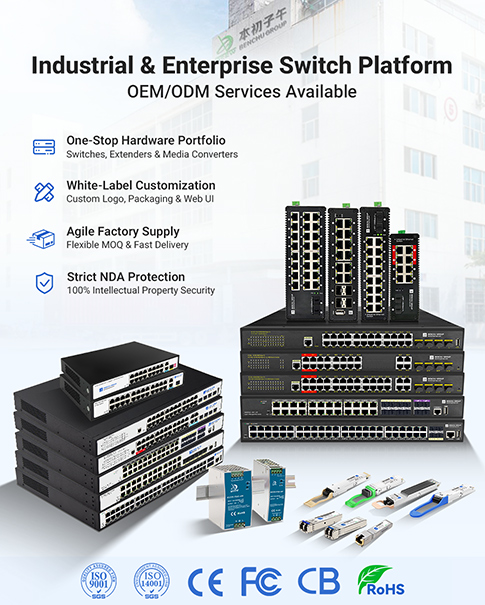
BENCHU works with networking brands, distributors, and system integrators on OEM/ODM and private-label opportunities. Share your target application, required interfaces, TSN functions, and project specifications so the team can review the relevant product options and customization requirements.
What information should we provide when requesting TSN switch details?
Include the application or industry, connected device types, required TSN standards or functions, RJ45 and fiber port requirements, uplink speeds, environmental conditions, and any OEM/ODM needs. These details help establish which specifications and compatibility points need to be reviewed.
BENCHU / OEM & ODM NETWORKING SOLUTIONS
Need a TSN Switch for Your Industrial Networking Project?
Selecting a TSN switch involves more than port count and bandwidth. Your project may also require specific TSN functions, fiber uplinks, network management features, or customized product specifications.
Contact BENCHU to discuss your requirements for:
TSN switch specifications and technical documentation
Port configuration and 10G SFP+ uplink requirements
Product evaluation and application compatibility
OEM/ODM and private-label opportunities
Share your target application, required interfaces, and preferred TSN functions so the team can help you review the relevant product specifications.
CONTACT BENCHU FOR TSN SWITCH DETAILS
CONSULTE MAIS INFORMAÇÃO

 Envia-nos um email
 Ligue para nós
 Endereço



 Rede IPv6 suportada
 Português