Unmanaged vs. Managed: Why an 8-Port 10G Unmanaged PoE++ Switch is Perfect for Edge Powering
Jun 30, 2026
WHITE PAPERPublished by Bench Group Research Lab
Quick Answer for Network Engineers
For network edge deployments handling next-gen Wi-Fi 7 APs and high-draw PTZ cameras, an 8 port 10g poe switch operating without a management layer offers superior stability, zero configuration overhead, and significantly lower TCO. By eliminating software complexity, it delivers pure hardware-driven line-rate throughput and seamless power delivery where Layer 2/3 management is redundant.
Key Takeaways
Zero Config Inflation: Plug-and-play architecture drastically reduces onsite engineering deployment costs.
Uncompromised Horsepower: Dedicated hardware chips ensure full 10Gbps non-blocking bandwidth per port.
Hardware-Level Safety: Autonomous power allocation manages severe camera startup spikes without software lag.
The Paradigm Shift at the Network Edge
The rapid adoption of Wi-Fi 7 enterprise networks and AI-driven perimeter security has fundamentally changed the engineering requirements at the network edge. Legacy gigabit networks are facing immediate bottlenecks. To support these next-generation applications, infrastructure engineers are forced to upgrade to high-speed copper interconnects. However, a critical architecture question arises during planning: Do edge access points truly require expensive and complex managed switches, or is a streamlined hardware solution more optimal?
Breaking the Myth: Managed vs. Unmanaged at the Edge
In enterprise core networks, managed switches are non-negotiable for traffic shaping, VLAN routing, and network segmentation. But when deployed strictly at the edge to distribute power and aggregate data from localized nodes, managed platforms often introduce unnecessary vulnerability, configuration bloat, and ongoing firmware maintenance overhead.
Swipe left / right to view full specifications table
Architectural Dimension
10G Managed Switches
10G Unmanaged Switches (Edge Optimized)
Deployment Velocity
Hours of manual IP/VLAN configuration per unit.
Instantaneous. Pure plug-and-play engineering.
Power Reliability
Software-dependent power negotiation; prone to crash.
Hardware-driven autonomous IEEE 802.3bt logic.
Edge Cyber Attack Surface
Vulnerable via Web UI, SSH, or SNMP endpoints.
Zero IP footprint. Complete software immunity.
Why a 10G Unmanaged PoE++ Setup Dominates Edge Powering
By stripping away the complex software operating system, a high-density unmanaged switch offers distinctive structural advantages for edge deployments:
A. Pure Hardware-Driven Line-Rate Throughput
Without a heavy network OS consuming CPU cycles, a dedicated 10g base-t unmanaged switch utilizes advanced ASIC chips to execute line-rate switching. This guarantees non-blocking packet forwarding across all ports simultaneously, ensuring zero-lag data transmission for high-bandwidth networks.
B. Bulletproof 802.3bt Power Handling
Deploying a heavy-duty 90w poe++ switch 8 port architecture down to the hardware level complies directly with IEEE 802.3bt Type 4 standards. When heavy PTZ tracking cameras activate infrared illuminators in sub-zero environments, the autonomous power distribution instantly handles severe startup current spikes without software glitches.
C. Drastic TCO Reduction for Integrators
For global system integrators and contractors, minimizing truck rolls is vital for profitability. An unmanaged architecture eliminates configuration drift and software bugs. Once plugged in, the hardware operates continuously without requiring remote IT support or manual firmware security patches.
Engineering Insights from Bench Group Lab
As a leading B2B hardware manufacturer based in Shenzhen, China, Bench Group specializes in delivering high-reliability networking hardware. Our engineering team designed the SP5210-8PTE-8BT specifically to solve the thermal and power challenges encountered at the physical edge.
★ Hardware Profile: SP5210-8PTE-8BT
300W
Centralized Power Pool
10Gbps
Per Port Copper Speed
90W
Ultra PoE++ Max Output
Port Density
Features 8-Port full 10-Gigabit Base-T RJ45 copper ports, backwards compatible with multi-gigabit bands for robust future-proofing.
Thermal Engineering
Ruggedized wide-voltage (100-240V AC) internal power supply matched with an optimized industrial-grade passive chassis to maintain absolute stability under continuous full-load environments.
OEM/ODM Flexibility
Fully customizable outer housing colorways, custom client silk-screened brand logos, and specialized localized power cords tailored for rapid global distribution channels.
Frequently Asked Questions (FAQ)
Q1: Will an unmanaged 10G switch cause data loops or network broadcast storms at the edge?
No, when deployed correctly as a localized edge device feeding into an upstream managed distribution switch. The upstream switch handles core loop prevention (such as STP/RSTP) and broadcast domain segregation, allowing the edge switch to focus purely on high-speed physical data line-rate forwarding.
Q2: Can I safely connect standard non-PoE devices to the 90W PoE++ ports?
Yes, completely safe. The SP5210-8PTE-8BT features automated smart detection circuitry complying with the IEEE 802.3bt protocol. It conducts a low-voltage hardware handshake prior to releasing power. If a non-PoE terminal (such as a 10G NAS or PC) is detected, the port safely transmits pure data only.
Q3: What are the OEM/ODM customization capabilities for overseas brands?
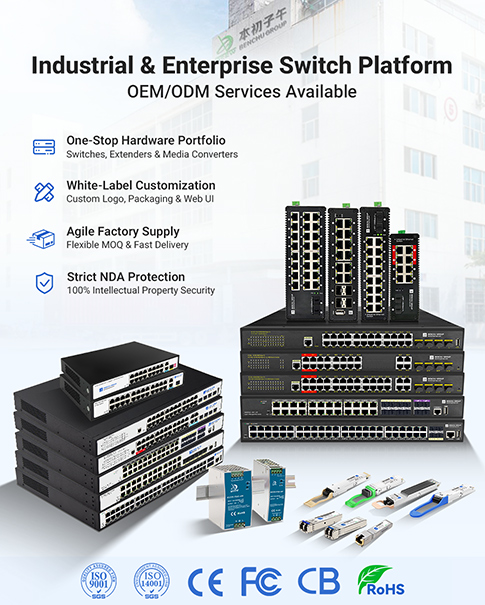
We offer complete B2B industrial customization. This includes custom brand logo placement, personalized packaging designs, variable chassis engineering, and regional compliance certifications. Our Shenzhen manufacturing plant provides flexible minimum order quantities (MOQs) and optimized international logistics support for hardware brands, distributors, and large-scale system integrators worldwide.
Upgrade Your Edge Infrastructure with Bench Group
Stop overpaying for unutilized management layers at your network edge. Deploy simple, highly reliable, industrial-grade power and speed instead.
Email our engineering team today at harry@benchu-group.com to request an engineering dataset, bulk wholesale pricing, or customized OEM/ODM evaluation samples.
CONSULTE MAIS INFORMAÇÃO

 Envia-nos um email
 Ligue para nós
 Endereço



 Rede IPv6 suportada
 Português