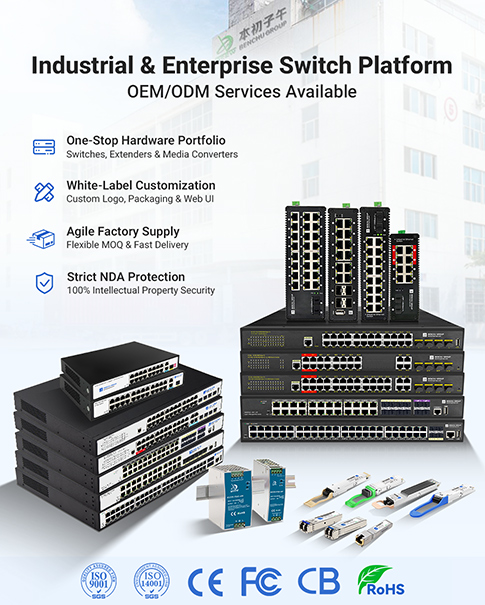
Factory Specs & Quotes
Get unbranded (white-label) PDF datasheets and custom MOQ options directly from our engineering team. Fast 24-hour response. 100% Privacy Guaranteed. No spam.

In the evolving landscape of enterprise networking and security surveillance, the traditional 100-meter limitation of standard Power over Ethernet (PoE) has become a significant bottleneck. As we transition into the era of Wi-Fi 7 and UHD 4K/8K video feeds, system integrators and network engineers are facing a critical challenge: how to provide high bandwidth, substantial power, and extended coverage distances without compromising network integrity.
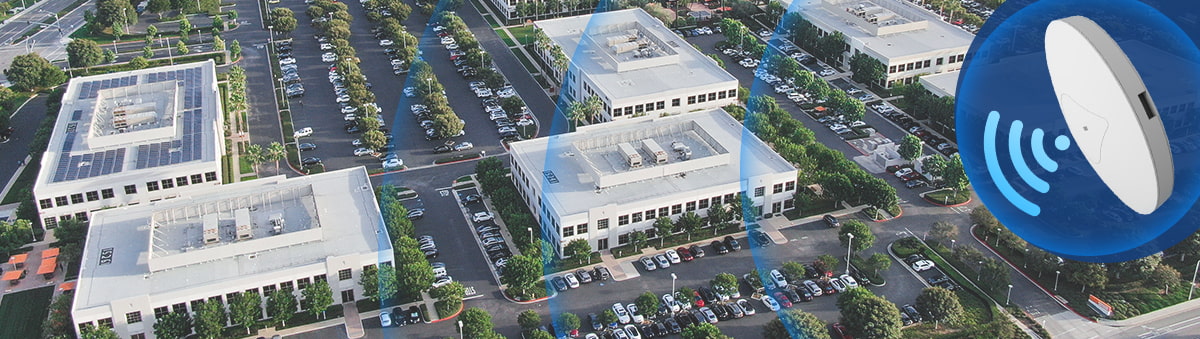
Standard Cat5e/Cat6 cables using IEEE 802.3af/at technologies are physically limited to a 100-meter data and power transmission distance. For Wi-Fi 7 Access Points (APs), which are designed to deliver multi-gigabit wireless speeds, locating them in optimal positions (often outdoor courtyards or distant warehouse ceilings) frequently exceeds this limit. Similarly, modern 4K surveillance cameras require higher bandwidth for crisp, uncompressed video, yet are often placed at the perimeter of large industrial sites, over 200 meters from the nearest MDF (Main Distribution Frame) closet.
To overcome these physical constraints, advanced telecom manufacturers have implemented hybrid cabling solutions. The core technology behind this breakthrough is not merely extending data via fiber optics, but simultaneously transmitting high-voltage DC power through the same cable infrastructure.
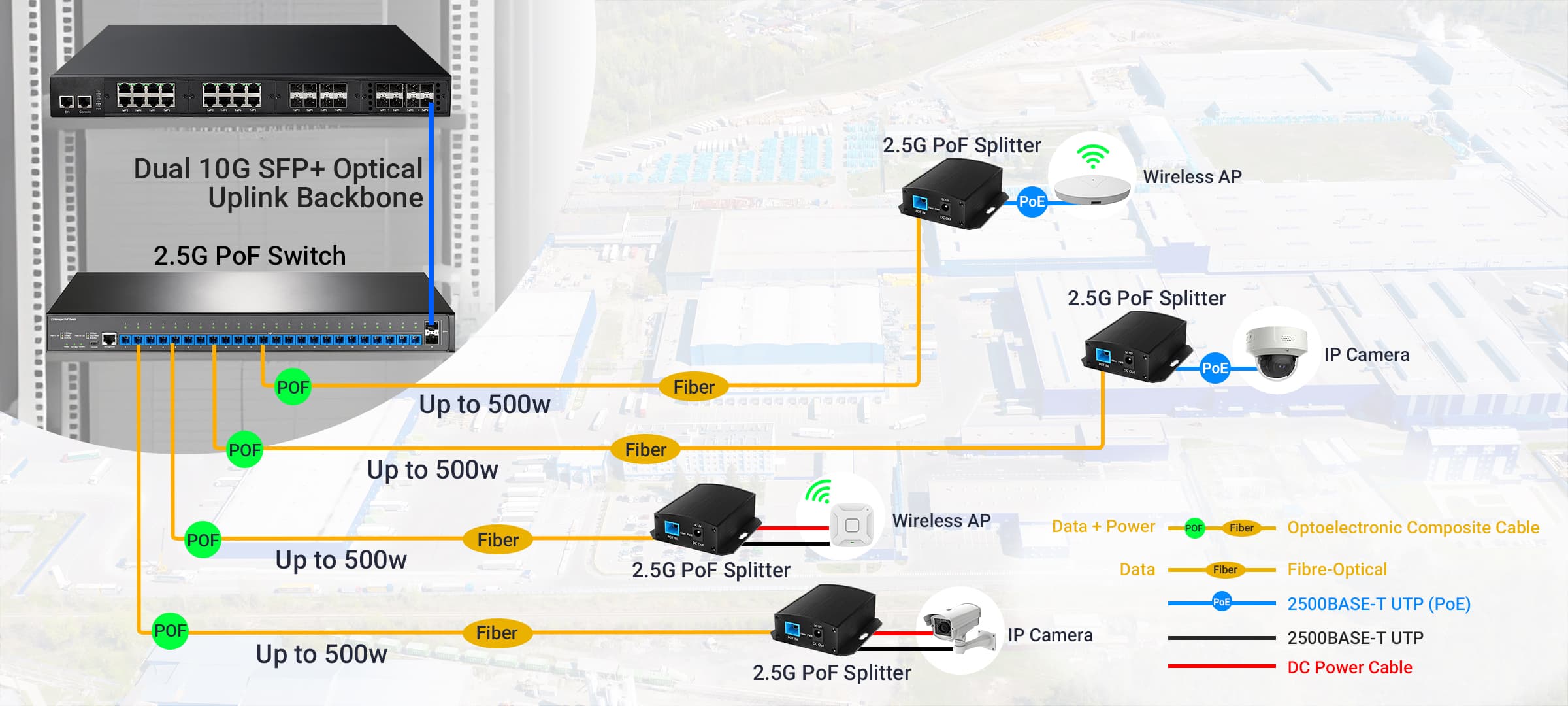
The new-generation L3 managed multi-gigabit switch integrates optical transceivers capable of handling data streams at 2.5Gbps. By utilizing a specialized hybrid cable that combines single-mode fiber optic cores with high-current copper wires, the switch maintains a stable connection over 500 meters. This hybrid structure significantly mitigates signal attenuation and voltage drops that plague conventional Ethernet systems.
| Metric | Capability |
|---|---|
| Max Transmission Distance | Up to 500 meters over hybrid cable |
| Port Configuration | 24 x 2.5GBase-T PoF Ports |
| Uplink Interfaces | 2 x 10GBase-X SFP+ |
| Switching Capacity | 300 Gbps non-blocking fabric |
Deploying a 24-port 2.5G Managed PoF (Fiber Power) Switch in the access layer ensures that each Wi-Fi 7 AP gets the exact speed it requires—2.5Gbps—without complex port aggregation. Furthermore, supporting Dual 10G SFP+ uplinks, the aggregated traffic from all 24 ports can be seamlessly forwarded to the core network via high-speed fiber connections. The built-in L3 routing capabilities and VLAN support (IEEE 802.1Q) allow network administrators to segregate traffic, ensuring that guest Wi-Fi, corporate data, and surveillance streams don't interfere with one another.
The 100-meter limitation frequently forces the installation of costly, weatherproof intermediate PoE extenders. The L3 Managed PoF Switch eliminates this by delivering power and data up to 500 meters via a single hybrid cable. With a 500W PoE budget providing 90W per port (IEEE 802.3bt compliant), it powers heavy-duty outdoor PTZ 4K cameras equipped with heaters and IR illuminators. For outdoor deployments, the industrial-grade IP67-rated casing ensures resilience against severe weather, lightning surges, and temperature fluctuations ranging from -20°C to 55°C.

As IEEE 802.3bt standards mature and the demand for 8K video and AI-driven analytics grows, the infrastructure layer must be redesigned for scalability. The 24-port 2.5G Managed PoF Switch represents a definitive architectural shift. For global system integrators and network brands, adopting this PoF technology ensures that their Wi-Fi 7 and 4K surveillance hardware operates at peak performance, regardless of physical layout constraints.
Whether for a high-rise commercial building or a sprawling smart factory, the capability to transmit power and data over 500 meters via a single, unified cable offers unmatched deployment flexibility and significant cost savings on both cabling material and labor.
To successfully deploy an intrinsically safe, centralized optical powering infrastructure, the system utilizes two complementary hardware elements. Explore our perfectly matched transmitter and receiver nodes below:
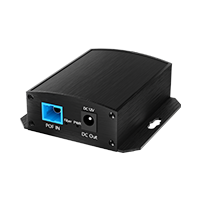
Looking to integrate this PoF technology into your own product line? As a leading OEM/ODM network communication manufacturer in Shenzhen, we offer full customization and white-labeling services.
Request OEM Samples & Technical Specs Envia-nos um email
 Ligue para nós
 Endereço
5F, Block5, GuangmingGu Industrial Park, Matian Villiage, Guangming Disitrict, Shenzhen, China



 Rede IPv6 suportada
 Português