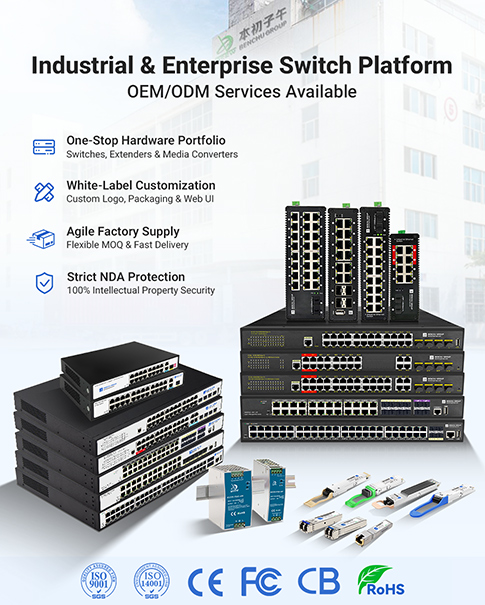
Factory Specs & Quotes
Get unbranded (white-label) PDF datasheets and custom MOQ options directly from our engineering team. Fast 24-hour response. 100% Privacy Guaranteed. No spam.

Comprehensive engineering criteria for selecting industrial PoE switches designed to deliver high-power Layer 2/Layer 3 networking, reliable video transmission, and long-term operation in harsh outdoor smart city surveillance environments.
An outdoor smart city industrial PoE switch is a hardened Ethernet networking platform designed for reliable high-power PoE delivery and stable data transmission in harsh outdoor environments. Available in managed Layer 2 or Layer 3 configurations, these switches support IEEE 802.3af/at/bt PoE technologies with power delivery up to 90W per port for advanced surveillance devices. Selecting the right industrial PoE switch for smart city deployments requires evaluating critical factors including -40°C to +75°C wide-temperature operation, fanless aluminum chassis with DIN-rail mounting, 6kV surge protection and enhanced ESD immunity, ITU-T G.8032 ERPS fast ring recovery, and PoE Watchdog automatic power-cycle recovery capabilities.
Outdoor municipal surveillance infrastructures require careful PoE budget planning due to peak power demands from multi-sensor panoramic cameras, PTZ motors, built-in enclosure heaters, and high-power IR illuminators.
When specifying an industrial PoE switch, the power supply architecture must provide sufficient PoE budget to support simultaneous high-power devices without thermal throttling or voltage instability.
Industrial PoE switches typically utilize external wide-range DC power supplies (e.g., 48V–57V DC for standard IEEE compliance) or AC-to-DC DIN-rail power units. Correctly sizing the power supply wattage and selecting dual-redundant power inputs are essential to prevent system reboots during peak thermal or motor startup loads.
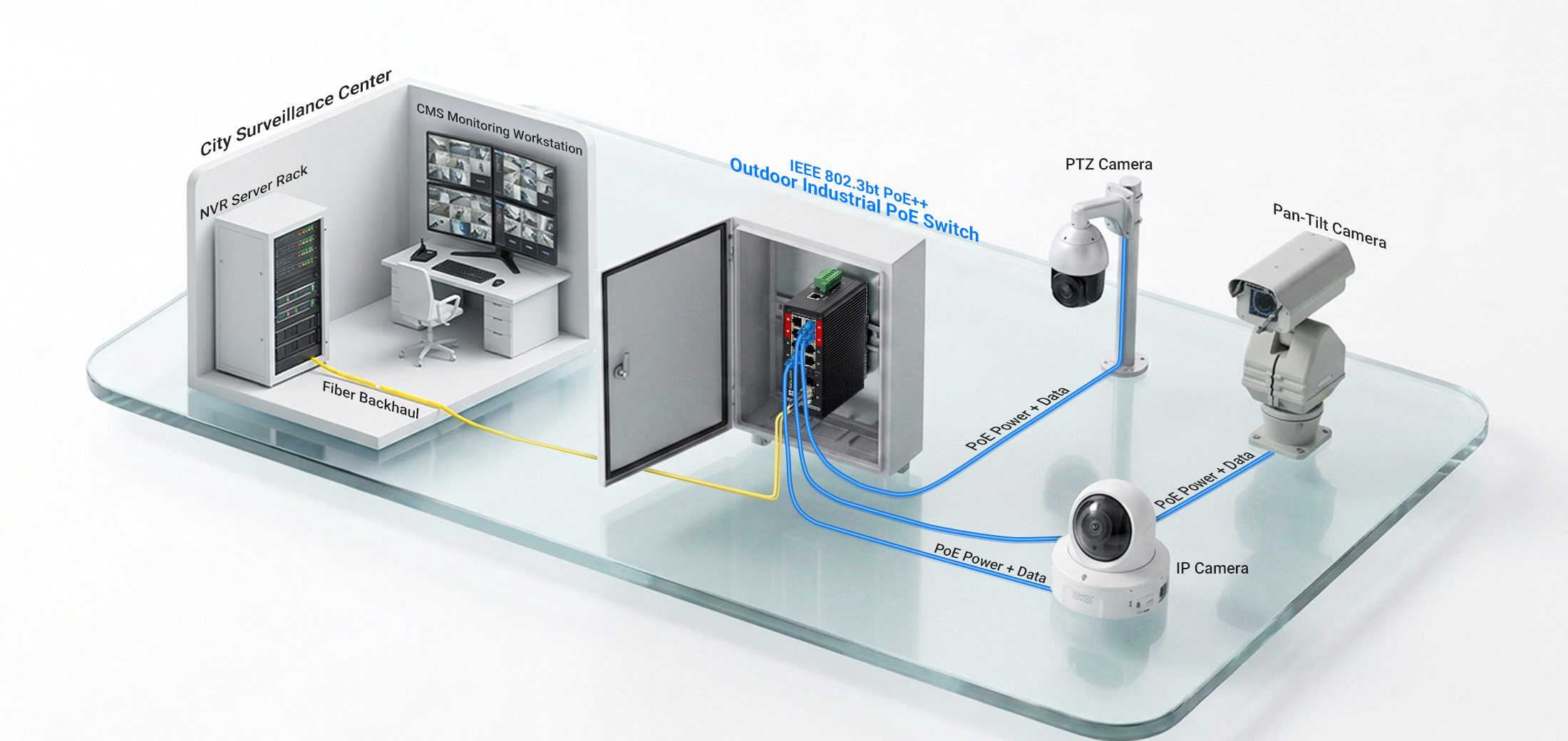
Outdoor Smart City Surveillance Industrial PoE Switch System Architecture Diagram, illustrating fiber backbone connectivity, industrial PoE switch deployment, IEEE 802.3bt PoE++ power delivery, and reliable network connections for PTZ camera, Pan-Tilt Camera, and IP cameras.
Commercial-grade Ethernet switches are not designed for direct deployment in unconditioned outdoor roadside cabinets, where temperature fluctuations, condensation, vibration, and power surges can significantly reduce operational reliability.
| Engineering Parameter | Commercial IT Switch Specification | Industrial Outdoor Requirement |
|---|---|---|
| Thermal Operating Window | 0°C to 40°C (Fan-cooled) | -40°C to 75°C Cold-Start Capable |
| Form Factor & Enclosure | 19-inch Sheet Metal / Plastic | IP40 Aluminum, DIN-rail Mount |
| Electromagnetic Immunity (EMS) | Basic ESD (1kV - 2kV) | Level 4 EMS: 6kV ESD / 4kV Surge |
| MTBF & Cooling Architecture | <100,000 Hours (Active Fans) | >500,000 Hours Passive (Fanless) |
Selecting a fanless DIN-rail PoE switch with an IP40-rated extruded aluminum chassis enables passive heat dissipation, improved vibration resistance according to IEC 60068-2-6, and reliable integration inside space-constrained NEMA-rated outdoor control cabinets.
Real-time video surveillance backhaul cannot tolerate packet loss or extended network recovery times. Traditional Spanning Tree Protocols (STP/RSTP) fail to meet mission-critical recovery speed requirements.
Municipal surveillance deployments using linear or ring topologies often require ITU-T G.8032 ERPS (Ethernet Ring Protection Switching) support. Deploying a managed industrial PoE switch configured with G.8032 ERPS ensures sub-50ms self-healing network failover during fiber cuts or single-node power failures, maintaining continuous video stream availability at the Central Management System (CMS).
Uncontrolled video traffic and multicast streams can overload roadside network infrastructure. Industrial edge nodes require advanced Layer 2 management capabilities to efficiently isolate, prioritize, and transport high-bandwidth 4K H.265 surveillance streams.
Prevents network flooding by forwarding video multicast streams exclusively to active subscribers, optimizing bandwidth utilization for NVR recording systems.
Isolates surveillance video traffic from public networks and IoT sensors, enhancing cyber security and traffic management.
Integrating a hardened industrial PoE switch with SFP uplink ports enables long-distance optical communication over single-mode fiber with transmission ranges exceeding 40km+ depending on transceiver selection.
Field technician dispatch costs represent a major Operational Expenditure (OpEx) for smart city operators. Camera software lockups require automated physical power cycling.
Modern managed switches integrate PoE Watchdog (Auto-PD Alive Check). The switch sends continuous ICMP ping requests to connected IP cameras. If a camera fails to respond within a defined interval, the switch automatically cycles DC power to that specific port, hard-rebooting the frozen camera without human intervention and restoring stream uptime automatically.
Before issuing requests for proposals (RFPs) for smart city surveillance infrastructure, verify that network specifications meet the following criteria:
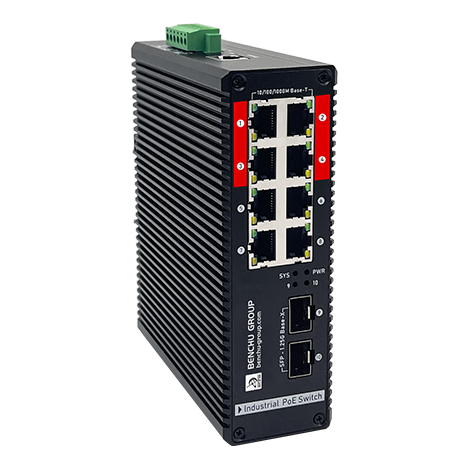
Model: IES7511-8PGE2GF-4BT-DC
Industrial PoE switches feature fanless wide-temperature components (-40°C to +75°C), IP40 metal enclosures, Level 4 EMS surge protection, and DIN-rail mounting for outdoor cabinets, whereas commercial switches are designed solely for indoor office environments (0°C to 40°C).
High-performance outdoor 4K PTZ and multi-sensor panoramic cameras require 60W to 90W to support motorized zoom, IR illumination, pan-tilt mechanisms, and enclosure heaters simultaneously. IEEE 802.3at PoE+ (30W) cannot supply sufficient power.
ITU-T G.8032 ERPS provides sub-50ms self-healing ring redundancy for fiber-based surveillance networks. If a fiber link is interrupted or a network node fails, ERPS redirects traffic around the ring with recovery times below 50 milliseconds under properly configured conditions, helping maintain continuous video availability.
PoE Watchdog continuously monitors connected IP cameras using ICMP ping requests. If a camera becomes unresponsive, the switch automatically performs a remote power cycle on that specific port, hard-rebooting the frozen camera without human intervention and reducing OpEx maintenance costs.
Looking for fully customized, hardened industrial PoE switches for smart city, traffic surveillance, or municipal infrastructure projects? As an experienced industrial networking manufacturer, we provide complete OEM/ODM solutions, including 90W PoE++ port configurations, custom PCB development, wide-voltage solar DC input designs, private labeling, and ISO9001-certified quality management with production testing.
Request Factory-Direct Quotation & OEM Catalog →
 Envia-nos um email
 Ligue para nós
 Endereço
5F, Block5, GuangmingGu Industrial Park, Matian Villiage, Guangming Disitrict, Shenzhen, China



 Rede IPv6 suportada
 Português