Types of Ethernet Switches: A B2B Engineering & Buyer Guide
Aug 03, 2026
Industrial Networking Selection Guide
Types of Ethernet Switches: The Ultimate Selection Guide for B2B Buyers
An engineering evaluation of management control vectors, environmental rating thresholds, topological distribution tiers, and high-wattage PoE architectures.
Executive Summary
Ethernet switches are defined by four core technical metrics: management capabilities (Layer 2/3 control), operational environment tolerances (-40°C to +75°C vs 0°C to 45°C), topological network hierarchy (Access, Distribution, Core), and power delivery specifications (IEEE 802.3af/at/bt up to 90W). Mismatched specification leads directly to physical layer degradation and thermal failure.
1. Types of Ethernet Switches by Management Capabilities
Ethernet switches can be classified by management capability, which determines configuration flexibility, security control, monitoring visibility, and network redundancy options.
Plug & Play Tier
Unmanaged Switches
Unmanaged switches are Layer 2 plug-and-play devices that require no software configuration. They automatically handle basic Ethernet functions such as link detection and speed negotiation but do not support advanced features like VLAN segmentation, network monitoring, or redundancy protocols. They are ideal for simple deployments including small offices, basic surveillance systems, and isolated edge connections.
Full Control Tier
Managed Switches
Managed switches provide complete administrative control for enterprise and industrial networks. They support advanced features including IEEE 802.1Q VLAN tagging, IEEE 802.1X authentication, QoS traffic prioritization, SNMP monitoring, and fast redundancy protocols such as ERPS (G.8032) and RSTP. These switches are commonly used in high-availability applications requiring network security, remote management, and reliable operation.
Hybrid Tier
Smart / Light-Managed Switches
Smart switches provide essential management features through a Web-based interface without the complexity of full CLI configuration. They typically support VLAN segmentation, port mirroring, and bandwidth management, offering a balance between functionality and cost for SMB networks and workgroup deployments.
2. Commercial vs Industrial Ethernet Switches: Environmental Rating & Mechanical Adaptation
Commercial and industrial Ethernet switches are designed for different deployment environments. The key differences include operating temperature range, mechanical construction, mounting methods, power input design, and protection against electrical hazards.
Technical Parameter
Commercial Enterprise Switch
Industrial Ethernet Switch
Operating Temperature
0°C to 45°C (Standard Indoor Environment)
-40°C to +75°C (Extended Temperature Operation)
Mounting Options
Desktop / 19-inch Rackmount
DIN-Rail (EN 50022) / Wall Mount / Industrial Enclosure Installation
Cooling Method
Active Fan Cooling
Fanless Passive Metal Heat Dissipation
Power Input
Internal AC Power (100V-240V)
DC Terminal Block Input (12V/24V/48V, Optional Redundant Power)
Surge Protection
Limited Basic Protection
6kV Surge Protection (IEC 61000-4-5 Level 4)
3. Ethernet Switch Types by Network Architecture: Access, Distribution, and Core Layers
Ethernet networks are typically structured into three hierarchy levels: Access, Distribution, and Core. Each layer serves a different purpose, from connecting endpoint devices to aggregating traffic and providing high-speed backbone connectivity.
Access Layer Switches
Access switches form the connection layer between end devices and the network infrastructure. They connect devices such as IP cameras, wireless access points, computers, and VoIP phones while providing features such as PoE power delivery, local security policies, and copper or fiber uplinks. Access switches are commonly deployed at the network edge where devices directly connect.
Distribution / Aggregation Layer Switches
Distribution switches aggregate traffic from multiple access switches and provide advanced functions such as inter-VLAN routing, QoS management, and network policy control. They typically use high-bandwidth fiber uplinks with modular Optical Transceiver modules, including 1G SFP, 10G SFP+, and 25G SFP28, to support large-scale data transmission.
Core Layer Switches
Core switches provide the high-speed backbone of enterprise and campus networks. They are designed for maximum switching capacity, high-density fiber connectivity, redundant hardware architecture, and reliable forwarding of large volumes of network traffic.
4. Power Delivery Specifications & Form Factors
Non-PoE switches provide network connectivity only and require separate power sources for connected devices. PoE switches combine Ethernet data transmission and DC power delivery over standard twisted-pair cables, simplifying deployment for powered devices such as IP cameras, wireless access points, and IoT systems.
IEEE 802.3af (PoE)
15.4W / Port
Designed for baseline lower-power endpoints like static IP cameras and VoIP desk phones.
IEEE 802.3at (PoE+)
30.0W / Port
Built for mid-range powered devices like HD PTZ cameras and Wi-Fi 6 wireless access points.
IEEE 802.3bt (PoE++)
Up to 90.0W / Port
Engineered for high-power demands including Edge AI nodes, heated outdoor PTZs, and Wi-Fi 7.
Frequently Asked Questions
Q: What is the primary operational difference between managed and unmanaged Ethernet switches?
Managed switches provide configurable network management features such as VLAN, SNMP, QoS, and redundancy protocols, enabling monitoring, security control, and traffic optimization. Unmanaged switches operate as plug-and-play Layer 2 devices without user configuration.
Q: Why are industrial switches preferred for outdoor cabinets instead of commercial enterprise switches?
Industrial switches are designed for harsh environments with features such as fanless operation, extended temperature support (-40°C to +75°C), rugged metal housings, DC power input options, and surge protection to improve reliability in outdoor and industrial deployments.
Q: Is an IEEE 802.3bt 90W PoE++ switch backward compatible with older 15.4W and 30W PoE devices?
Yes. IEEE 802.3bt PoE++ switches are designed to support IEEE 802.3af (PoE) and IEEE 802.3at (PoE+) powered devices through automatic classification and power negotiation.
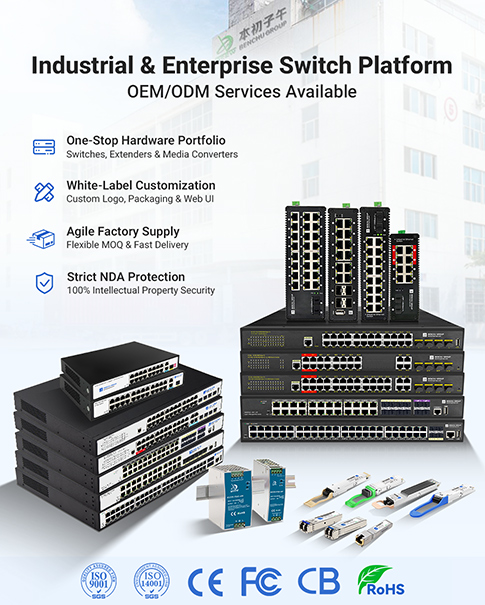
Empower Your Hardware Portfolio with Factory-Direct OEM/ODM Solutions
As an established original equipment manufacturer specializing in industrial networking infrastructure, we offer flexible OEM/ODM manufacturing partnerships. From custom PCB layout to wide-temperature screening, our factory delivers rapid execution.
Contact Our OEM/ODM Engineering Team →
{
"@context": "https://schema.org",
"@type": "FAQPage",
"mainEntity": [
{
"@type": "Question",
"name": "What is the primary operational difference between managed and unmanaged Ethernet switches?",
"acceptedAnswer": {
"@type": "Answer",
"text": "Managed switches provide software-based control protocols (VLANs, SNMP, QoS, ERPS ring recovery) for network monitoring, whereas unmanaged switches operate strictly as plug-and-play Layer 2 hardware."
}
},
{
"@type": "Question",
"name": "Why are industrial switches required for outdoor cabinets instead of commercial enterprise switches?",
"acceptedAnswer": {
"@type": "Answer",
"text": "Industrial switches use fanless wide-temperature components (-40°C to +75°C), IP40 metal housings, dual DC inputs, and 6kV surge immunity to prevent failure under thermal spikes."
}
},
{
"@type": "Question",
"name": "Is an IEEE 802.3bt 90W PoE++ switch backward compatible with older 15.4W and 30W PoE devices?",
"acceptedAnswer": {
"@type": "Answer",
"text": "Yes. IEEE 802.3bt PoE++ hardware is fully backward compatible with IEEE 802.3af (15.4W) and 802.3at (30W) standards through automated hardware handshake classification."
}
}
]
}
CONSULTE MAIS INFORMAÇÃO

 Envia-nos um email
 Ligue para nós
 Endereço



 Rede IPv6 suportada
 Português